
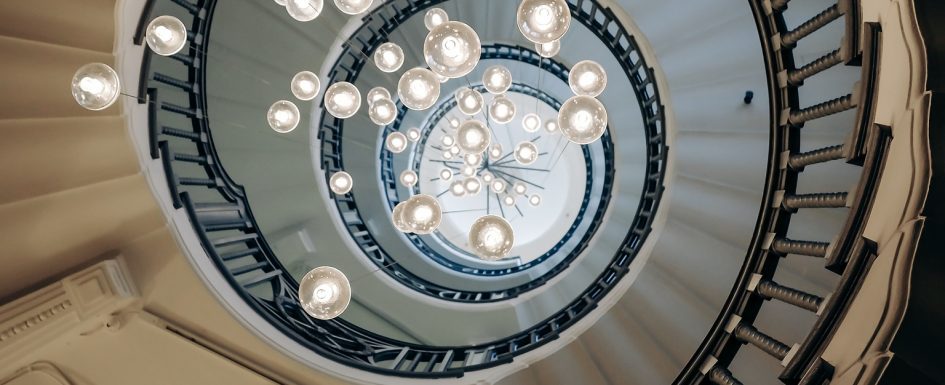
You may have a staircase in your home that you’ve been looking at for years without knowing how to change it. This article covers that functional space that sometimes forgets to be beautiful or to match your style. We’ll walk through different ways to transform a staircase — both decoratively and structurally — depending on what it needs. For more decorating inspiration, see our dedicated guide on staircase decorating ideas and interior designer insights.
By Clara AJMAR, Certified Interior Architect & Landscape Designer DPLG (updated May 2026)
A staircase can be functional and beautiful. It just depends on which direction you take it.
1. Decorating your staircase: how to make it a design feature
2. Decorating stair risers with durable materials: ideas and tips
3. Staircase inspiration: metal, wood, and concrete
4. Improving what exists: strengthening the structure or replacing the railing
5. The lightweight staircase: custom wood or metal structure
6. The heavy-duty staircase: masonry rebuild, tile, and concrete finishes
7. Frequently asked questions
Decorating your staircase: how to make it a design feature
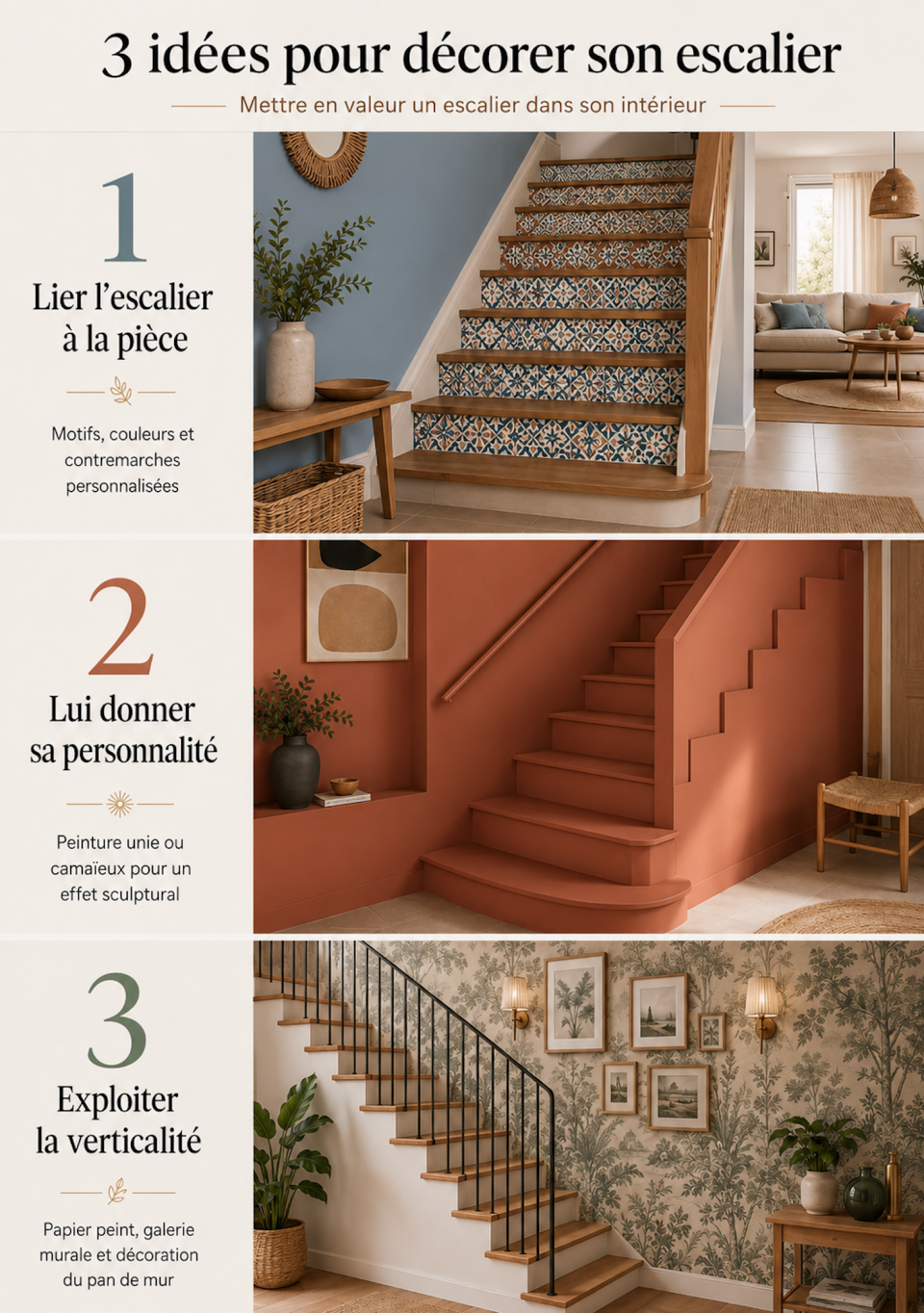
Your staircase, your rules. There are three main directions you can take it: tie it visually to the adjacent space (hallway, living room, landing), give it its own identity even if it contrasts with the rest of the interior, or play on its verticality as a design tool. The first option means matching colors, patterns, and materials with the neighboring space. Decorative adhesive panels on the risers are one of the easiest and most reversible approaches — you can change them with the seasons without any structural work.
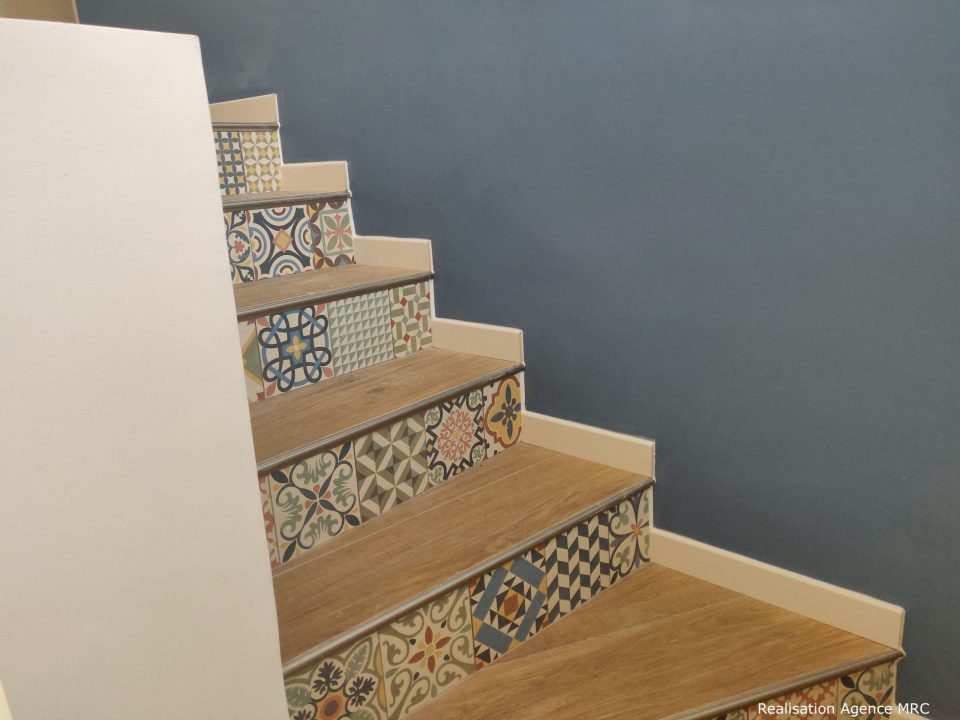
This staircase was fully rebuilt in masonry with a new structural opening. The treads are wood-effect tile with an overhanging nosing for durability and safe footing. The risers are finished with adhesive cement tile-effect panels — a cost-effective, decorative solution that can be swapped out without touching the structure.
Decorating stair risers with durable materials: ideas and practical tips
Paint is the most versatile tool for the second approach. Painting the staircase wall and the staircase itself in the same color creates a striking standalone feature within the room. You can also work through tonal gradients, moving from a deeper shade at the bottom to a lighter one at the top, to give a sense of upward movement and visual lightness.
For the third direction — working on the wall rather than the steps — a single-wall wallpaper installation makes perfect sense. Heavily patterned wallpapers are often designed for a single wall precisely because repeating them on all surfaces would feel overwhelming. The staircase wall becomes the ideal location for that bold statement paper you can’t stop thinking about.
Staircase inspiration: metal, wood, and concrete
Wood for warmth and visual comfort, metal for an industrial edge and structural lightness, polished concrete for a contemporary restraint — the right choice depends on the overall style of your home. Combining two materials often produces the most balanced result. A matte black metal railing against light wood treads is the go-to pairing that works in most modern interiors.
Lighting is often an afterthought when it comes to staircases, yet it can completely change the experience. Recessed LEDs under each tread, light strips along the stringer, or alternating wall sconces all highlight the staircase form while making it safer at night. Lighting stops being a technical requirement and becomes a design layer in its own right.
Renovating a staircase does not always mean tearing it out or replacing it entirely. Depending on the structural condition, level constraints, available space, and style goals, several approaches are available: masonry rebuild, custom metal fabrication, a finish-only makeover, or a full redesign of the surrounding space. The following sections cover each method with real project examples.
Improving what exists: strengthening the structure or replacing the railing
When the staircase structure is sound, the intervention can focus entirely on finishes and peripheral elements. Replacing the railing is usually the single most impactful change: swapping out an aging wood balustrade for a metal or glass version completely reframes the staircase and the space it passes through. Tread resurfacing, baseboard treatment, wall decoration, and paint choices all contribute to making the staircase feel more contemporary, more legible, and better integrated into the overall interior.
This approach works well when the structural bones are solid and the goal is to improve the look, safety, and usability without committing to a full demolition. It limits costs while producing a genuine shift in how the space reads. In some cases, reworking the partitions and volumes around the staircase rather than the staircase itself can be enough to give it a completely new presence.
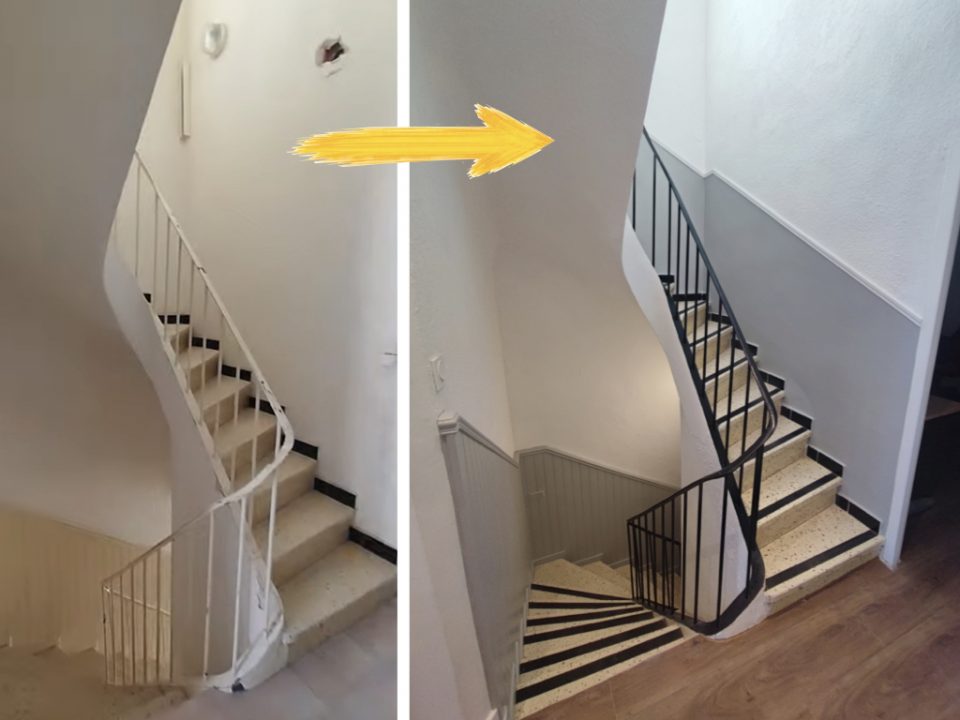
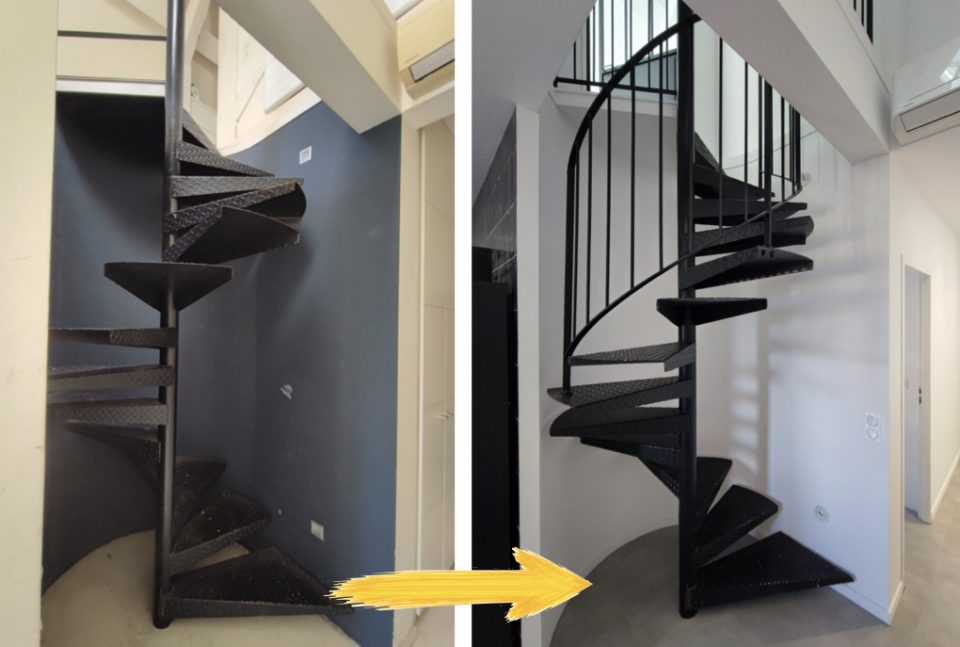
Before deciding to keep an existing staircase, always check the condition of the stringers, the stability of the treads under load, and how securely the railing is fixed. A staircase that creaks or shifts under weight cannot be fixed with surface finishes. Structural assessment comes first, even when the final goal is purely aesthetic.
The lightweight staircase: custom wood or metal fabrication
When the project allows for a new staircase from scratch — or for replacing an aging structure — a custom wood or metal solution offers the greatest architectural freedom. The design can include open or closed risers, exposed or concealed stringers, solid wood or metal treads, and load-bearing elements bolted into the walls where the configuration allows. This work is typically done in collaboration with a metalworker or a carpenter, depending on the chosen material.
On these projects, the design work covers structural safety and stability just as much as visual lightness. A cantilevered tread staircase or a central-spine design can appear to float while being perfectly rigid, provided the structural calculations have been done correctly. The staircase becomes a full architectural element, capable of organizing the volume while preserving a sense of openness and height.
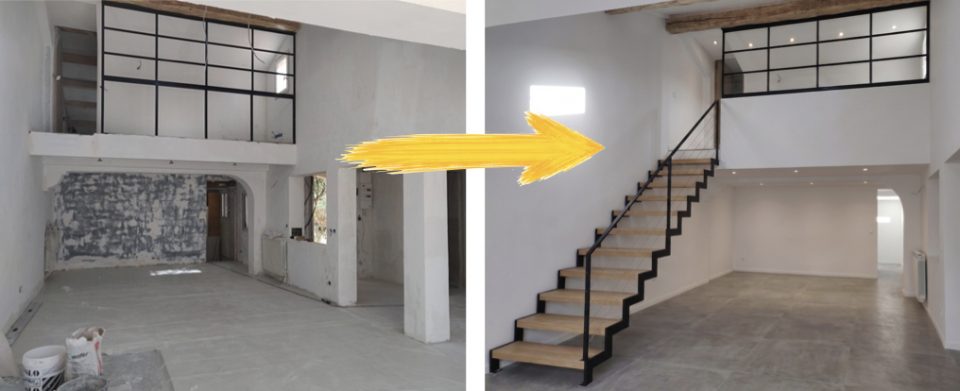
For a custom metal staircase, the fabricator must work from finalized floor levels. A 3/8 in discrepancy in rise height between the first and last tread may seem negligible but creates a perceptible inconsistency underfoot and fails most building codes. Coordination between trades — masonry, tiling, and joinery — is essential before fabrication begins.
The heavy-duty staircase: masonry rebuild, tile, and concrete finishes
When level differences, irregular shapes, or tight installation constraints rule out a standard solution, the staircase can be rebuilt entirely in masonry, lightweight aerated concrete block, or concrete block before being finished with tile or a mineral coating. This type of rebuild demands precise verification of finished floor levels, finish material thicknesses, tread nosing details, and the connection to existing floor surfaces at each level.
The result is a staircase that is fully integrated into the building fabric — solid, durable, and tailored to the real constraints of the project. It also opens up the widest range of forms: curved treads, variable going depths, and built-in storage under the staircase. The final finish — tile, polished concrete, or stone — dresses a masonry base that will not move.
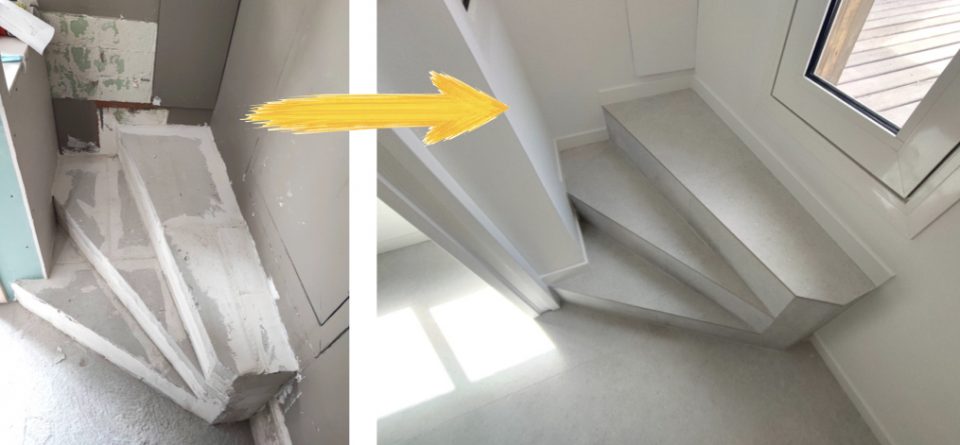
On masonry staircase rebuilds, the most consistently underestimated item is floor leveling. Between the structural rebuild, the screed, any insulation, and the finish material, layers add up fast. Losing 1.5 to 2.5 in of headroom clearance at the first level is common when this calculation was not done upfront. Verify with your architect before committing to the method.
The video below shows how a masonry staircase rebuild fits into a complete mezzanine apartment renovation. The structural choices, tile finishes, and layout decisions are all commented on in detail.
Find all our renovation and interior design projects on the ArchiWorking YouTube channel.
Clara AJMAR


Frequently Asked Questions About Staircase Renovation and Decorating
How do I give my staircase a new look without a full renovation?
Paint, adhesive panels on the risers, or a new railing can transform a staircase without any structural work. Coordinating the tones with the adjacent space or going for a bold contrast turns the staircase into a genuine design feature rather than a transitional element.
What are the best ways to finish stair risers with tile or decorative adhesives?
Adhesive panels, decorative tiles, or wallpaper strips all work well on risers. They are easy to install and swap out, giving you a unique finish that can evolve with your tastes. Adhesive cement tile-effect panels are particularly effective for achieving a period look without any wet work.
What decorating ideas work best for the wall that runs alongside a staircase?
A gallery wall of frames, bold graphic wallpaper, monochrome paint, or atmospheric lighting all work well. The staircase wall frames the vertical journey between levels — it deserves as much attention as any main wall in the house.
What materials should I choose for a modern staircase — wood, metal, or polished concrete?
Wood for warmth, metal for an industrial or minimalist look, polished concrete for contemporary restraint. Mixing two materials — typically a matte black metal railing with wood treads — usually produces the most balanced result. The right choice depends on the overall style of the space.
How do I refresh an old wood staircase and make it feel contemporary?
Sanding, a light stain, or matte paint are often enough. Playing on the contrast between treads and risers — painting the risers a bold color while keeping the treads natural wood — creates a strong effect with minimal investment. Replacing the balustrade with a contemporary metal version is usually the single most impactful change.
What lighting solutions work best for a staircase?
Recessed LEDs under each tread, a continuous light strip along the stringer, or wall sconces alternating on either side of the flight all highlight the form and improve safety at night. Staircase lighting should be designed as a decorative layer, not an afterthought.
Can I hang wallpaper on a staircase wall without it peeling or getting damaged?
Yes, provided you choose a vinyl or washable wallpaper designed for high-traffic areas. A single-wall installation is usually the right approach — it adds drama without the space feeling overwhelmed.
How do I bring natural materials and plants into a staircase space?
Hanging plants, woven baskets, or wood-framed artwork bring warmth and texture. Combined with soft directional lighting, these natural elements turn the staircase into a living corner of the house rather than a purely functional passage.
How do I combine railing, paint, and finishes for a staircase that is both stylish and safe?
A matte black metal railing, a single bold wall color, and textured or slip-resistant treads deliver both visual coherence and functional safety. The design should balance aesthetic intent with daily comfort — a beautiful staircase that is difficult to use safely is a failed project.