
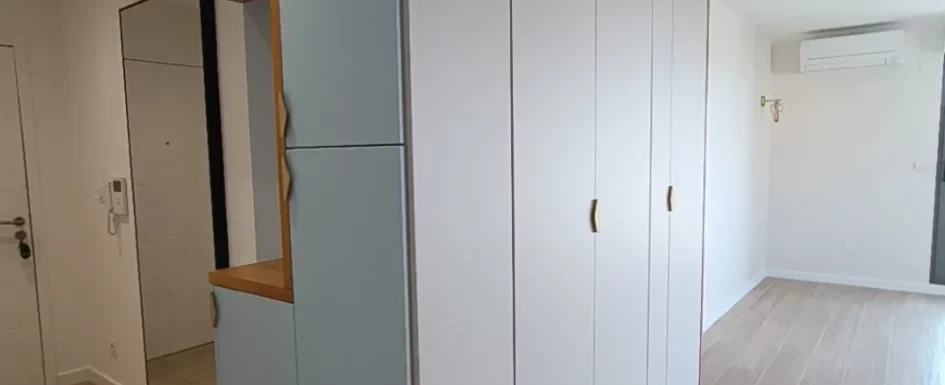
Creating a real entryway in a narrow hallway is entirely doable — the key is designing around how people actually use the space, not around the furniture. This project shows how a built-in hallway storage unit can structure the passage, deliver generous storage and add lasting design character, all without blowing the budget. Find more interior design tips for turning tight spaces into genuine assets.
By Clara AJMAR, interior architect & landscape designer DPLG – May 2026
A hallway without an entry is just a hallway. The difference is in how you think about it.
1. Starting point: a long, dark hallway with no defined purpose
2. The 3-part design concept: cabinet boxes, premium doors and solid wood
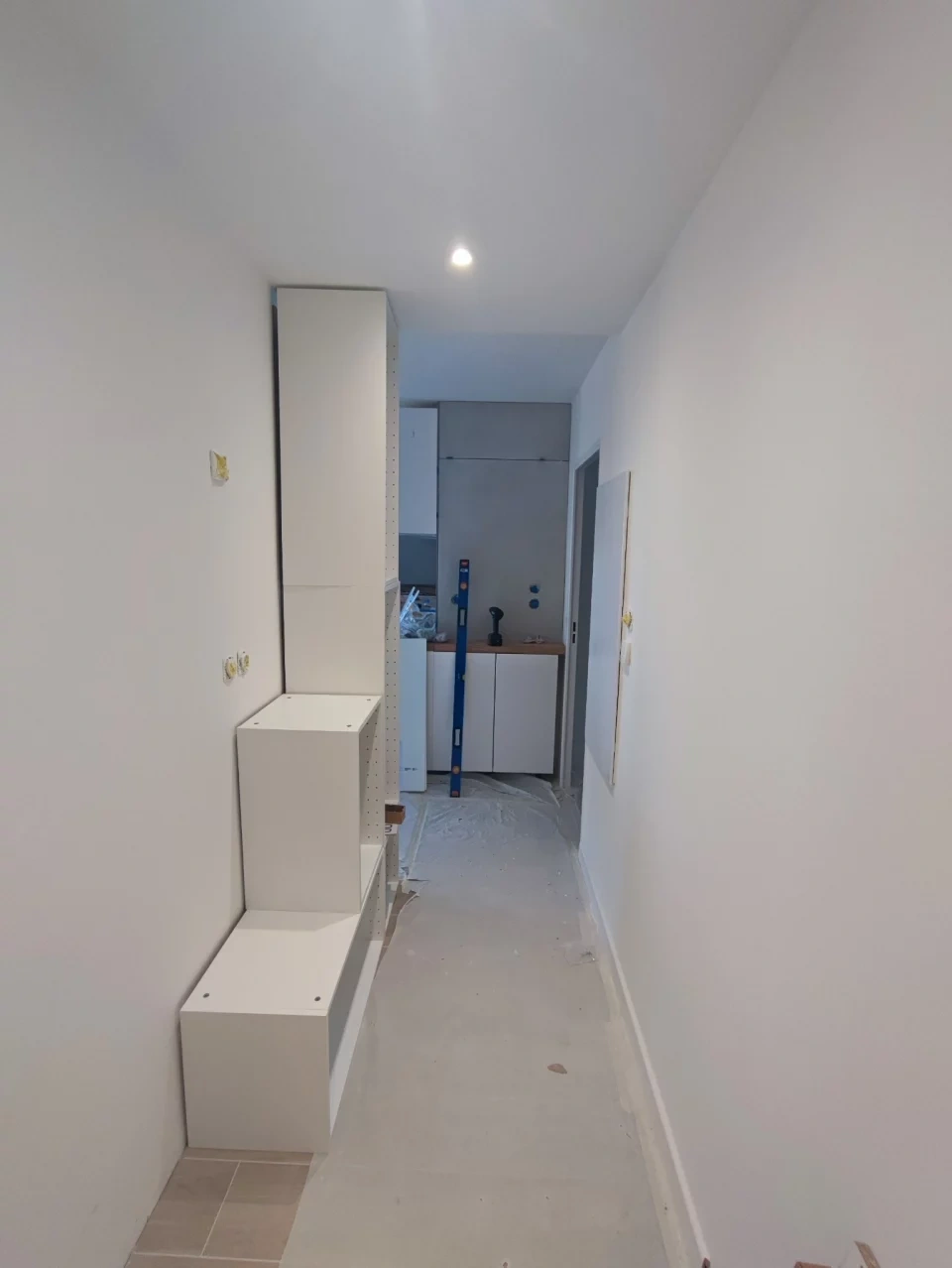
3. Prep work: what to sort out before installing anything
4. Installing the cabinet boxes: depth and clearance rules
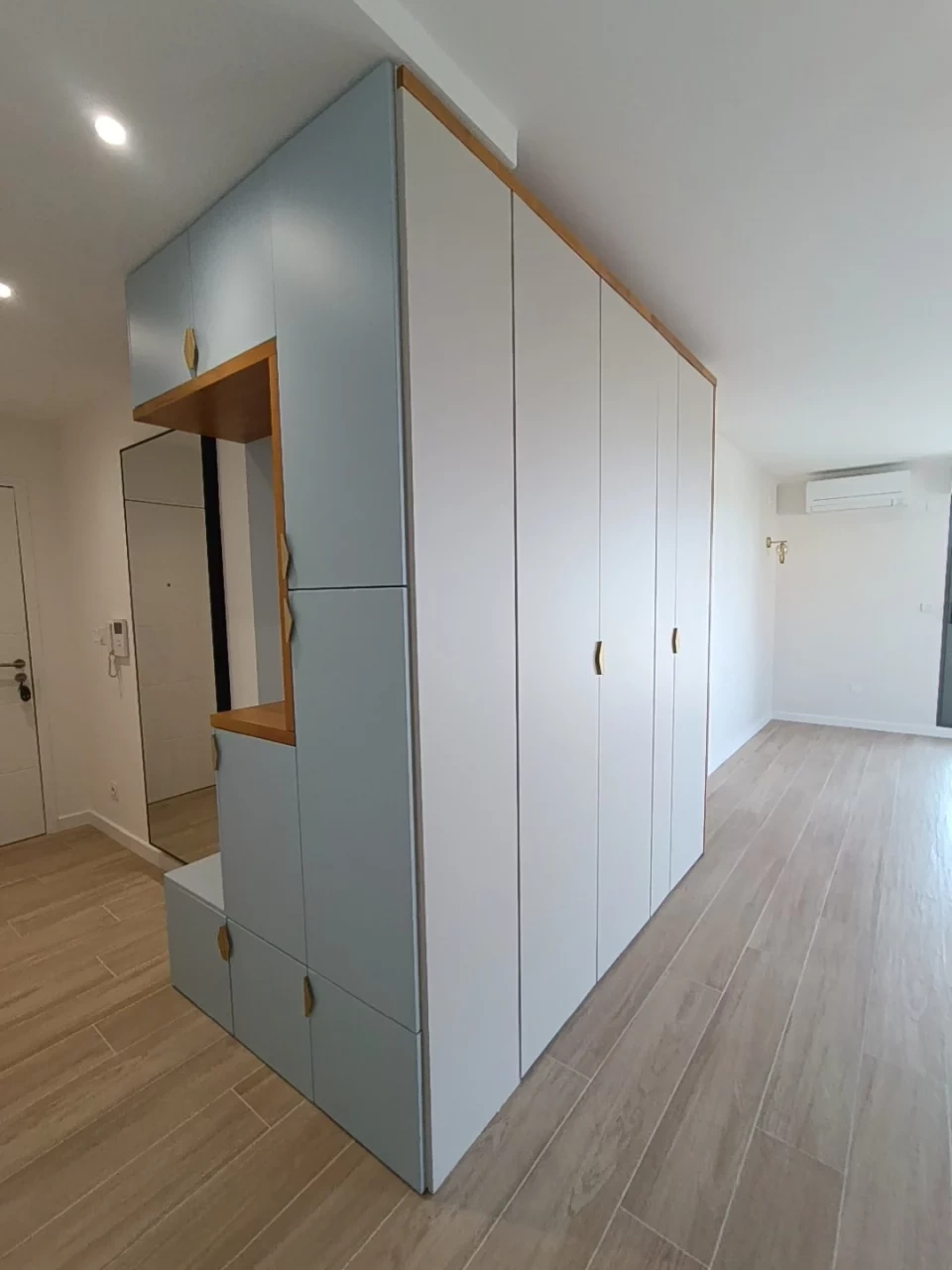
5. Door panels, adjustments and solid wood details
6. Before and after: a hallway that finally works
Clara and Mathieu walk through the project and every design decision in this video.
Starting point: a long, dark hallway with no defined purpose
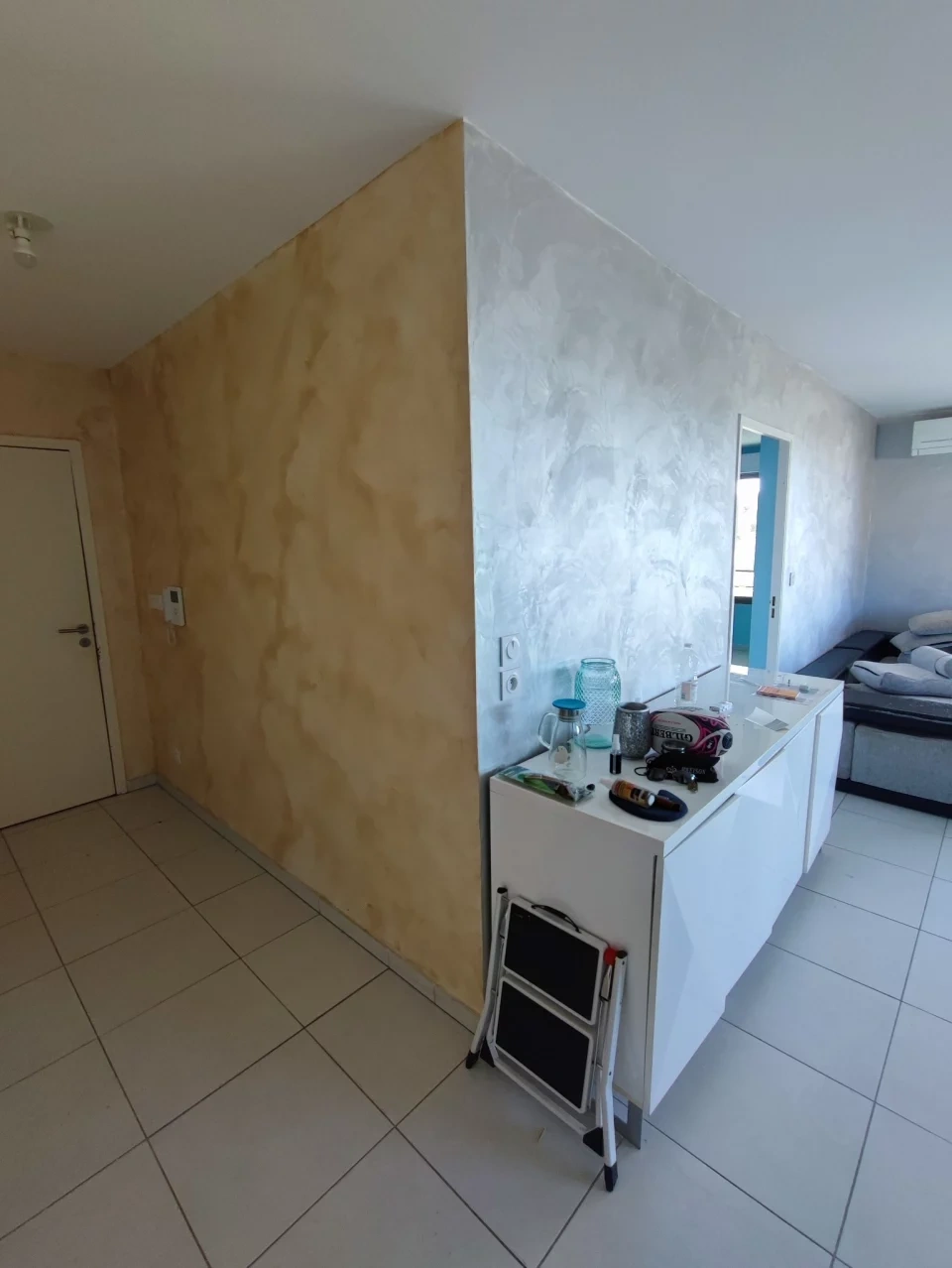
The hallway was long, had no clear function, little natural light and completely bare walls on both sides. This configuration is common in apartments built between the 1980s and 2000s: the hallway connects rooms but doesn’t exist as a space in its own right. The goal was twofold — build a practical drop zone at the entry and clear clutter out of the living area, while keeping comfortable clearance throughout.
The key constraint was dimensional. In any hallway, usable circulation width should never drop below 28 inches (about 70 cm) — that’s the bare minimum for one person in a coat. The comfort target is 33 inches (about 85 cm), which allows for easy movement when carrying bags or groceries. The entire storage design was built around those two benchmarks.
The 3-part design concept: flat-pack cabinet boxes, premium door panels and solid wood
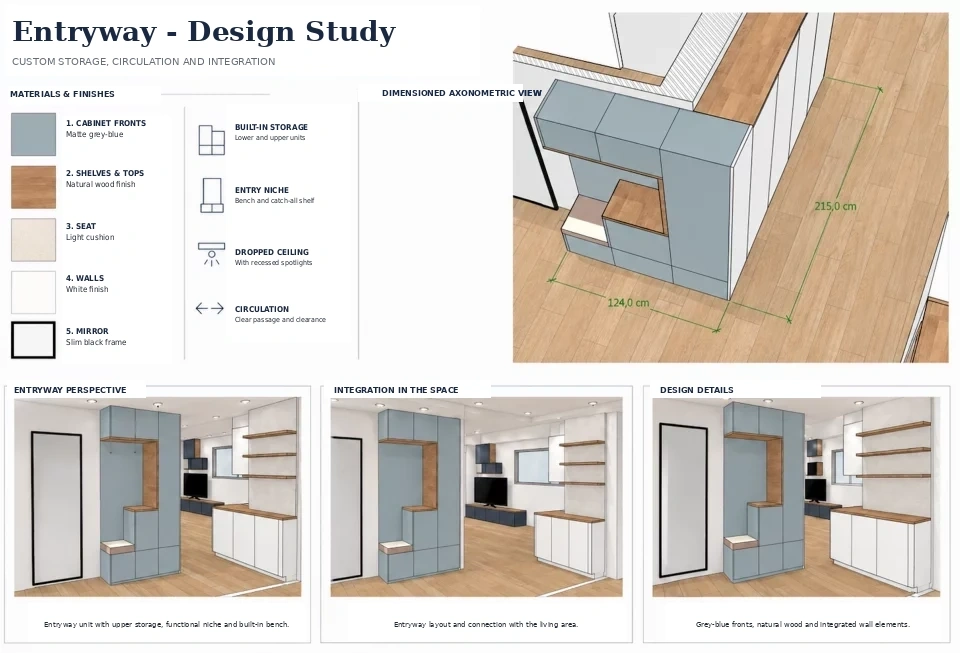
To balance budget, aesthetics and quality, the design combines three elements. Flat-pack cabinet boxes — the kind you’d find at IKEA — provide the structure and keep costs in check without sacrificing durability. Premium replacement door panels in a soft blue paired with off-white bring the contemporary, cohesive look that the boxes alone can’t deliver. Finished solid wood, cut to size, serves as the shelf, bench seat and trim detail that pulls the whole thing together.
This layered approach — standard structure, premium finish, natural material — consistently delivers the best value-for-money in hallway entryway projects. On this build, the budget broke down as follows: IKEA cabinet boxes around $550, premium door panels (Plum Living) around $1,550, solid wood countertop around $220, installation and assembly around $440. Total: roughly $2,750 for a result that reads as fully custom.
Cabinet depth is the most consistently underestimated spec in hallway entryway projects. Under 14 inches (35 cm) finished depth, adult shoe storage and coat hanging become inadequate. Over 16 inches (40 cm), you start eating into circulation. The 14 to 16 inch range is the sweet spot. On this project, the flat-pack boxes were selected specifically to land in that window.
What to prep before installing a hallway built-in: the work that comes first
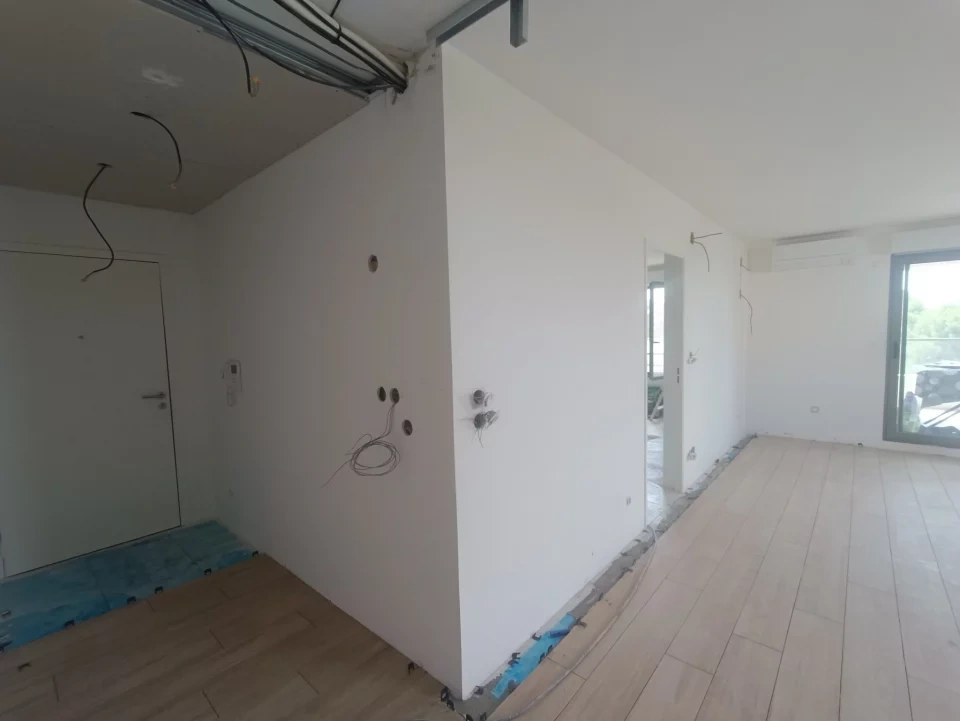
Before any cabinet goes in, several steps need to happen. Surface prep — patching, skim coat and paint — has to come first. In a hallway that hasn’t been touched in years, walls tend to have enough variation that cabinetry can’t sit flush or level without correction. Running plumbing, electrical and HVAC checks comes next, along with a dropped ceiling if you’re routing ductwork or adding recessed lighting.
Flooring continuity is the step most often planned too late. The tile or hardwood running under and around the unit needs to be specified before you order the cabinets, not after. The transition detail at the base — how the flooring meets the unit, where the baseboard goes — is what separates a clean installation from one that looks patched together.
Installing the cabinet boxes: how to size for depth and clearance
The cabinet boxes are the functional backbone of the entryway. Lower units provide the bench seat and shoe storage. Tall columns handle coats, bags and seasonal items. Cabinet depth was sized to maintain 33 inches of clear circulation in the highest-traffic section of the hallway. Wall and ceiling adjustments during installation ensure a stable, level fit with consistent reveals and a door line that reads as one continuous unit from floor to ceiling.
For apartments where there’s no existing hallway to work with at all, the approach to creating an entryway when there isn’t one walks through how to define a drop zone visually from scratch, with even tighter constraints.
Door panels, hardware adjustment and solid wood trim: the details that make the difference
Door alignment and hinge adjustment determine the visual quality of the finished result. Managing vertical and horizontal reveals consistently is what separates a well-installed unit from a flat-pack that looks like a flat-pack. Minimal bar pulls and soft-close hinges complete the picture for quiet, smooth daily use. The soft blue and off-white combination unifies the hallway perspective and makes the space read wider.
The solid wood comes in last, cut to fit the exact profile of the unit. It sits across the bench and shelf, becomes the drop zone surface and adds the material warmth that elevates the whole thing beyond what the boxes alone could achieve. It’s a simple detail technically — but it’s the one that shifts the perception from “assembled furniture” to something that feels designed.
On hallway storage projects, the temptation is to try to fit everything in: shoes, coats, vacuum, stroller. You end up with a unit that’s too deep and chokes the hallway. The better approach is the reverse: lock in your minimum clear width first (28 or 33 inches depending on the comfort level you’re targeting), then fit the storage into what’s left. The furniture adapts to how you live, not the other way around.
Before and after: a hallway that finally works as an entryway
Day to day, the entry now has a clear purpose: keys get dropped, shoes come off on the bench, coats and bags have a place. The full-height mirror opens up the hallway visually and bounces light back into the space. The living room stays clear of the clutter that used to spill out from a hallway with nowhere to put anything.
A long, underused hallway became a functional, well-designed entryway with integrated storage and preserved circulation. The before and after makes the gain tangible: more order, more light, more coherence — all felt from the moment you walk through the door.
This entryway is part of a full renovation of an 86 m² (925 sq ft) apartment. To see how the hallway choices connect to the overall floor plan — open kitchen, living room, circulation — Clara and Mathieu walk through the complete architectural logic in this video.
See all our renovation and design projects on the ArchiWorking YouTube channel.
Clara AJMAR


How deep should a hallway built-in closet be?
The ideal finished depth is 14 to 16 inches (35 to 40 cm). Under 14 inches, adult shoe storage and coat hanging become inadequate. Over 16 inches, you start cutting into the circulation path. In any hallway, keep at least 28 inches (70 cm) of clear walkway — 33 inches (85 cm) is the comfort target for daily use with coats and bags.
How much does a custom hallway entryway built-in cost?
For a custom-look result using flat-pack cabinet boxes with premium replacement door panels and a solid wood top, budget $2,200 to $3,300 installed. On this project: IKEA boxes around $550, premium panels around $1,550, solid wood countertop around $220, installation around $440 — roughly $2,750 total. That’s two to three times less than a fully custom built-in at the same visual quality level.
How much clearance do you need in a hallway with built-in storage?
28 inches (70 cm) is the absolute minimum for one person to pass comfortably. 33 inches (85 cm) is the comfort standard — enough for easy movement while carrying bags or wearing a bulky coat. Measure your hallway width, subtract your target clearance and that gives you the maximum cabinet depth available. Always lock in the clearance number before sizing the furniture.
Do you need to do construction work before installing a hallway built-in?
In most cases, yes. Wall prep, patching and paint need to happen before any cabinet goes in. Flooring continuity under and around the unit has to be planned before you order the boxes, not after. A cabinet installed against an unprepped wall or on an unfinished floor can’t be leveled cleanly, and the result shows immediately.
Flat-pack cabinets with custom fronts vs. fully custom built-ins: which is worth it?
Flat-pack boxes with premium replacement door panels and a natural wood countertop consistently deliver a result that’s visually very close to fully custom built-ins — at two to three times the savings. The boxes provide solid, modular structure. The door panels and wood surface carry the design. For hallway entryway projects with a defined budget, this is almost always the smarter call.