
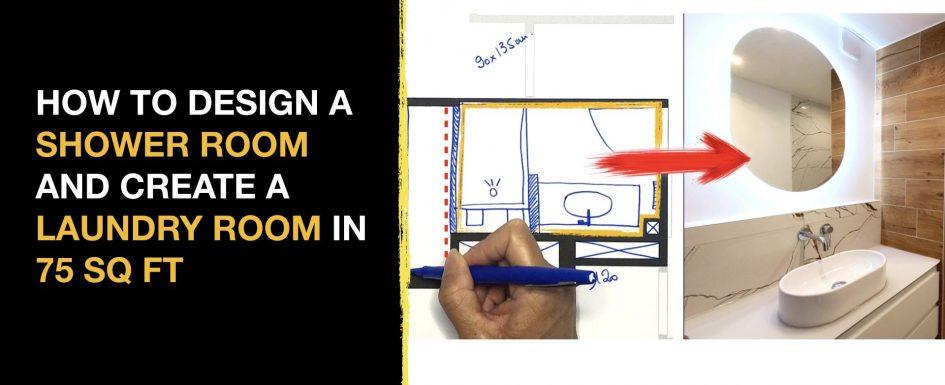
75 sq ft poorly used in a co-owned apartment: a 38 sq ft shower room with no privacy, and an adjacent 38 sq ft room that was tiled but had no defined purpose. The goal: fully reconfigure the whole space to create a functional shower room with a walk-in shower, vanity and niches, and build a complete laundry room with a water point, worktop and storage. All of it without touching the load-bearing walls, using the existing utility lines.
By Clara AJMAR, Interior Design & Landscape Specialist (updated June 2026)
Shower room and laundry room: two independent spaces, designed and optimized together around the lines and the layout.
1. Redesigning a shower room that opens onto a hallway
2. Designing a 38 sq ft shower room with shower, vanity and niches
3. Turning a room with no water point into a laundry room
4. Fitting a washer and storage into a small laundry room
5. The renovation stages: demolition, partitioning and finishes
6. Frequently asked questions
Clara and Mathieu walk through the full floor plan, the trade-offs, the alternative version and the jobsite in this video.
How to redesign a shower room that opens onto a hallway in an apartment
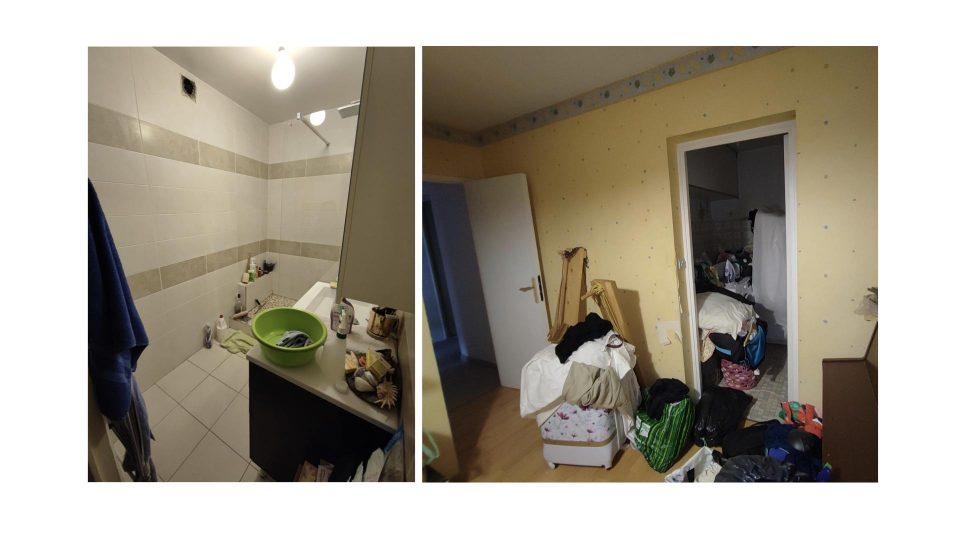
The starting point is a 38 sq ft shower room that opens directly onto the apartment’s main hallway. Two immediate problems: a 21-inch pinch point at the passage, and a complete lack of privacy caused by a surface-mounted sliding door. The existing shower sits on a significant step, on a tiled base about 12 inches high, with a perimeter boxing that eats into the space. The vanity is poorly placed. Everything needs to be redone.
The first decision is to remove the surface-mounted sliding door in favor of a proper hinged door, for better insulation and privacy, with real sealing in terms of sound insulation and even indirect visibility. Then we start from a clean slate: full removal of all sanitary fixtures, the boxing, the shower base and the vanity, to rebuild on a clean foundation. The shower room has a rare asset: three technical chases carrying various lines (heating, greywater drainage) well distributed, which gives great freedom to reposition the fixtures. To understand the levers for optimizing a small shower room, our article on a small bathroom remodel with closet conversion details the method with a real case study.
A surface-mounted sliding door seems practical on paper, but it insulates poorly, rarely seals tightly against sound, and requires a clear stretch of wall. In a shower room that opens onto a busy hallway, the hinged door is almost always the best choice for privacy and insulation, provided you check on the plan that its swing does not obstruct any fixture. The sliding door works well for a sanitary space within a master suite or for other uses, but it will always provide less privacy and insulation than a hinged or even a pocket door.
How to design a 38 sq ft shower room with shower, vanity and niches
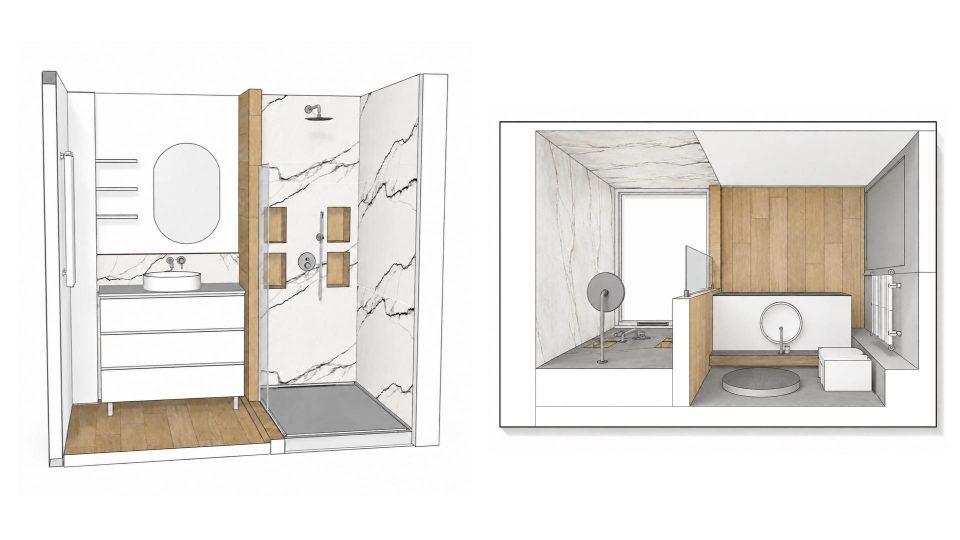
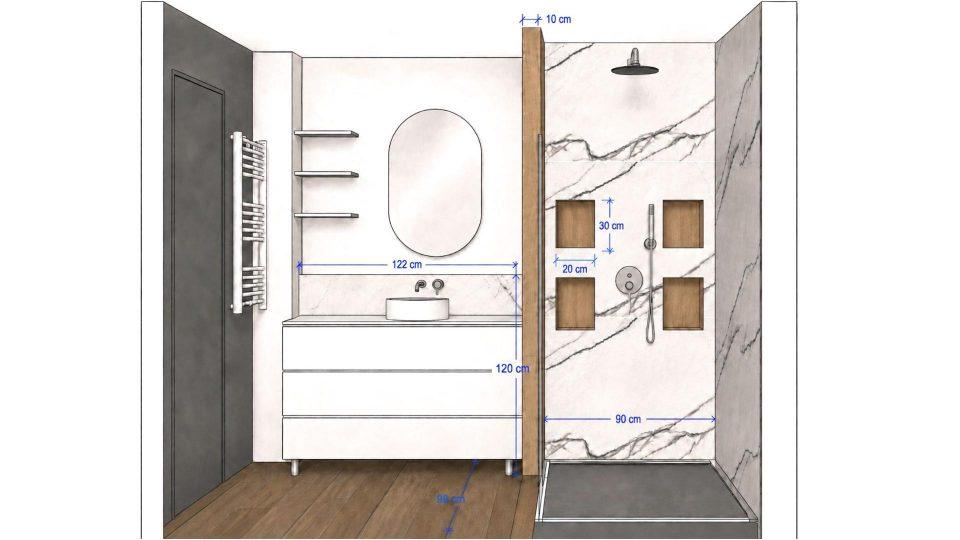
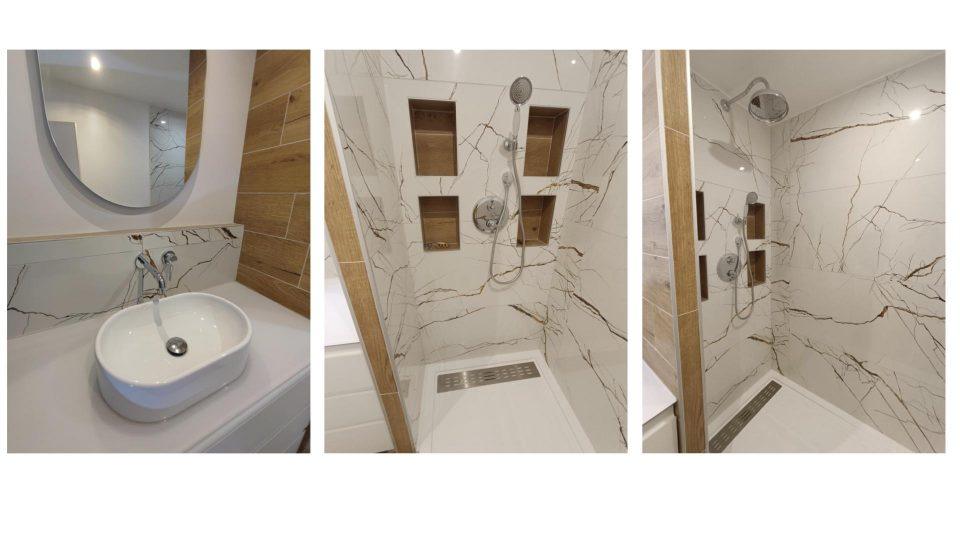
In this 38 sq ft room, every inch counts, and once fitted out it even feels spacious. The chosen shower base is an extra-flat porcelain stoneware base of 35 x 53 inches, positioned on the existing drainage side. To install it cleanly, we run a full-height partition and a fur-out wall: this fur-out fills the remaining space while allowing the passage of lines for the recessed faucet and the four large niches of 12 x 8 inches shown on the drawings. The owner wanted plenty of built-in storage, so we created these four niches in the shower wall.
Next to the shower, the available space is exactly 48 inches. We install a 47-inch vanity, so nearly the full width up to the technical chase. The basin is a countertop model, oval and centered, with a wall-mounted recessed faucet like in the shower. The unit is 34 inches high with three drawers, recovering appreciable storage over 47 inches. A shelf is added above, not for technical reasons (the chases are already at the back) but to hold products and improve everyday comfort. Finally, the chase connected to the collective heating carries a towel warmer wired directly, after a purge was carried out on the heating circuit in coordination with the building’s plumbing.
How to turn a room with no water point into a functional laundry room
In the extension of the shower room sits a small 38 sq ft room, tiled but with no water point or defined use. Its history remains unknown, even to the current owner. The idea was to reconfigure it into a complete, independent laundry room, away from the apartment’s living areas, mainly for noise. The easy technical access from the shower room allows the lines to be reworked cleanly and a water point to be created where there was none.
The work on the partition shared by the two spaces is used to purge, realign cleanly and correct existing defects. We strip out, reset to flat, and rebuild on a sound base with a new partition slightly thinner than the old one, recovering a few precious inches. A hinged door is installed for the laundry room, consistent with the one in the shower room. For the steps to anticipate in a co-ownership before this kind of work on the lines, our article on converting a bathtub to a walk-in shower covers the necessary checks.
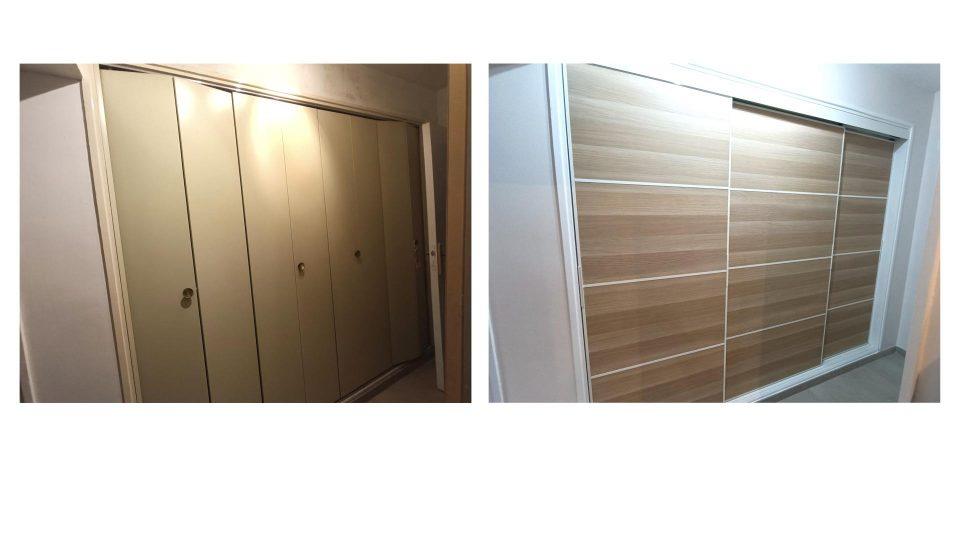
Beyond the shower room and laundry room, other adjacent spaces were reworked in this project, including an old closet. Rather than demolishing it entirely, we kept its existing frame and structure, then cut and reworked them to fit the new use. This approach, keeping the sound frame and only redoing what must be redone, optimizes both cost (less removal, less rebuilding) and the final result. A closet properly reworked on its original frame often blends in better than an entirely new unit. And if you have additional work, having the tradesperson already on site often helps optimize the overall cost of intervention on the same batch of work: it’s logical, but worth repeating.
How to fit a washer and storage into a small laundry room
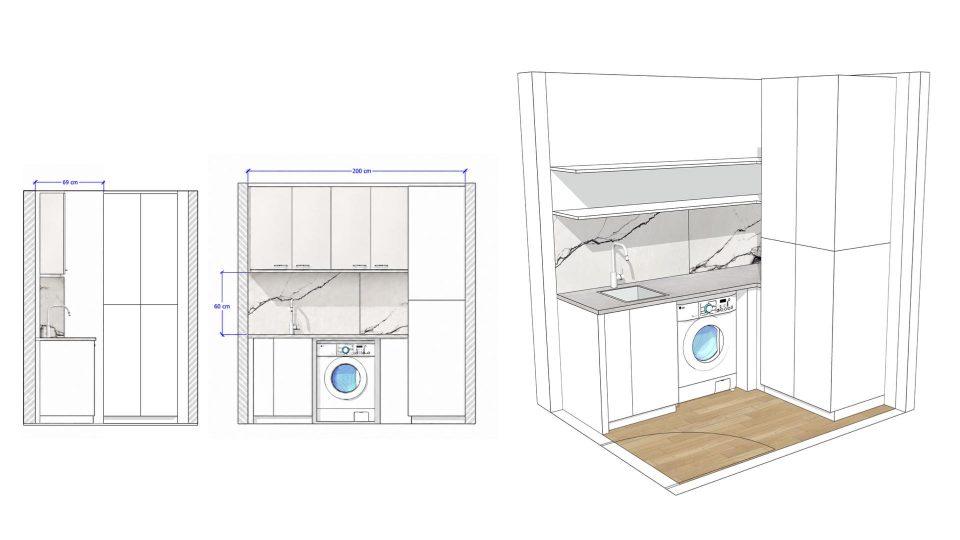
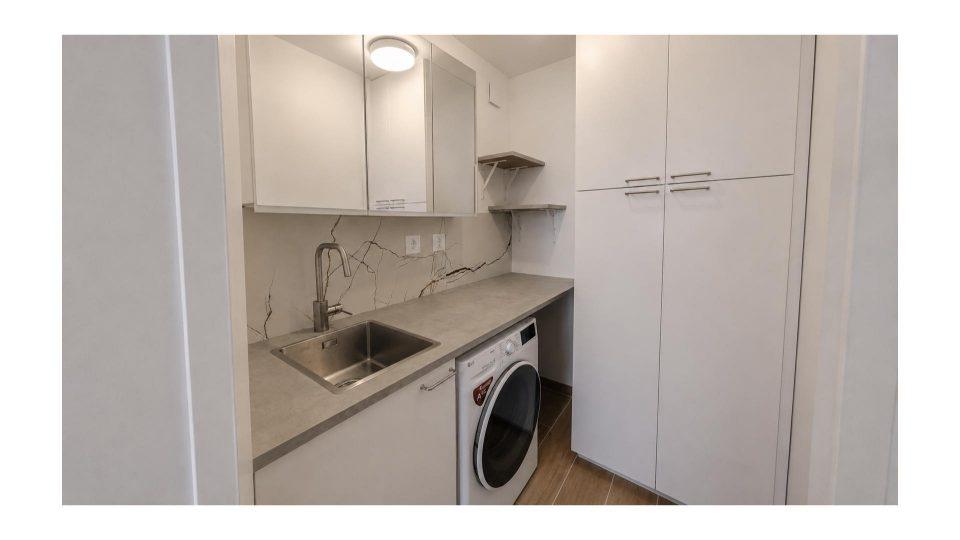
In the version approved by the owner, the laundry room is organized around a 6.5-foot worktop running the full length, with a water point and a small sink. Underneath, a washing machine fits below the worktop, complemented by storage. Wall units are installed above to use the height. The collective heating chase at the back is kept.
A specific feature of this layout: two storage columns 24 inches deep and 16 inches wide each, not against the wall, forming a full-height unit 31 inches total. This slight offset is no accident: it keeps the passage, uses the corner, and answers a precise request from the owner who wanted to store vertical items like an ironing board or a drying rack.
An alternative was also studied, with a double worktop and the option to fit a stacked washer and dryer: more full-height storage, but with a small loss of space in the recess. The single-worktop version was ultimately chosen for its flow.
Offsetting storage units a few inches from the wall in a corner may seem counterintuitive when you’re trying to maximize space. In reality, it frees up a narrow but very useful vertical storage slot for long, flat items (ironing board, folding drying rack, broom) that have nowhere else to go in a home. It’s an optimization of use, not of surface.
What are the stages to renovate a shower room and create a laundry room
Once the project is approved and formalized with the right drawings, the jobsite follows a precise order. First the removals: we take out the existing, boxing, shower base, vanity, and reset everything to flat to rebuild on a clean, sound base.
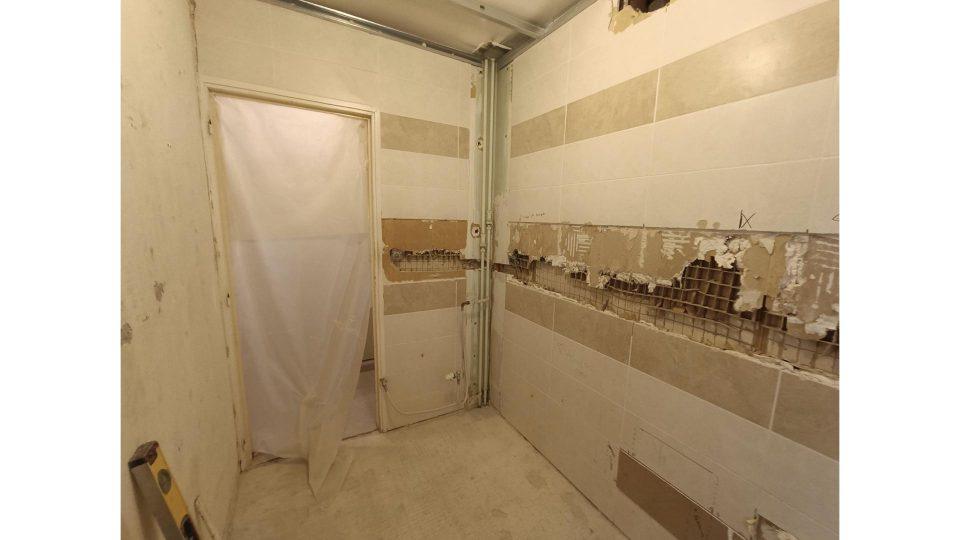
Next comes the new partitioning, with modification and creation of the lines to match the new layout. This is a critical phase: before closing the partitions, we check that both spaces work well, that the layouts are coherent and that each element is in its place. The partitioning and dropped ceiling are built, then the plastering is done. This is where the space really takes shape.
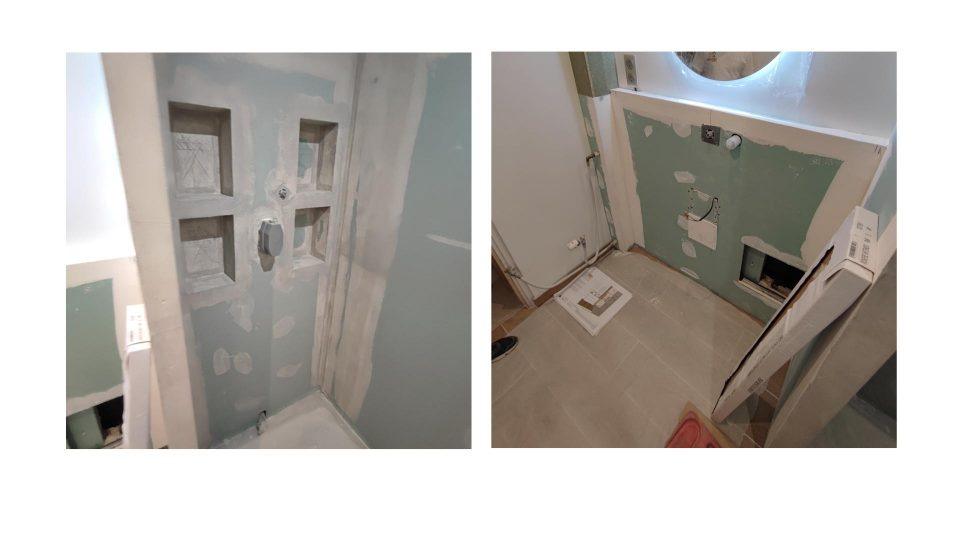
The floor treatment is prepared with a few patches to ensure continuity of laying. The niches take shape, the shelf is drawn with its access panels and line access points. Then come the painting and the finishing trades: tiling, trim beads, wood and marble effects, and the installation of fittings. The dropped ceiling houses the mechanical ventilation, with a run reaching the correct chase on each side. The final goal: a clean finish and two spaces far more functional than at the start.
Clara AJMAR


Frequently asked questions about designing a shower room and a laundry room
What is the minimum area to create a separate laundry room in an apartment or a house?
A functional laundry room can be designed from about 22 to 38 sq ft. In that area, you fit a worktop with a water point, a washing machine in the lower section, low storage and wall units. The essential condition is access to the lines: water, drainage and electricity. If the room has no water point, creating one remains possible when a technical chase or a drain is nearby, to be checked on the plan before any work. This is advice we always give: check on the plan, because a simple sketch helps materialize a volume and find the right avenues of thought.
Can a complete shower room with shower and vanity fit into 38 sq ft?
Yes, it’s possible, and this project is one example among many featured on this site and the ArchiWorking channel. Here, 38 sq ft fit a shower (a 35 x 53 inch base in this project), a 47-inch vanity and a towel warmer, provided the layout is worked around the existing drainage. The recessed faucet and the niches built into the fur-out wall save space without encroaching on circulation. Below about 32 sq ft, you need to reduce the shower or opt for a more compact vanity.
How to turn a room with no water point into a laundry room?
Feasibility depends on the proximity of a water supply and a drain. When a technical chase or a shower room is adjacent, as in this project, you can run a supply and connect a drain to create a water point where there was none. Work on the shared partition is the chance to purge and realign the lines cleanly. In a co-ownership, any change affecting the common chases must be checked with the building management. There are then solutions for moving water and concealing the lines: raised technical floor, boxing, plinth, lifting pump, dropped-ceiling casing. The point is to define the advantages and constraints of each scenario before proceeding.
What is the difference between a bathroom and a shower room?
A bathroom has a bathtub, whereas a shower room is fitted with a shower. The shower room is generally more compact, which makes it the preferred solution in small volumes and optimization projects. A well-sized shower, like a 35 x 53 inch base, offers comfort equivalent to a bathtub for daily use, while freeing up usable surface.
How to fit a washer and storage into a small space?
A continuous worktop is the most efficient solution: the washer sits in the lower section, under the worktop, with storage next to it and wall units above. To optimize a corner, storage columns slightly offset from the wall create a narrow vertical slot, ideal for long, flat items (ironing board, drying rack). The challenge is to use all the available height without blocking circulation. You need to use the layout and the heights to build usable spaces: a washer and dryer stack easily in a small room, a loggia or a storage space, and you quickly build an efficient laundry room.
Do you need co-ownership approval to create a water point in an existing room?
Creating a water point inside a private unit generally does not require co-ownership approval if it does not affect the common chases or the building’s waterproofing. However, as soon as the work concerns a common technical chase, a collective drain or modifies shared lines, a check with the building management is necessary. This remains to be confirmed according to the co-ownership rules and the exact nature of the work.
Why make a floor plan before renovating a shower room or a laundry room?
Because in a small volume, each technical decision conditions another: the position of the shower determines that of the vanity, which determines the available storage. Working on the plan beforehand allows you to compare several layouts, check that the lines follow, and anticipate constraints before they become extra costs during the jobsite. On this project, it was the plan that made it possible to arbitrate between the chosen version and the alternative, by visualizing the latter’s loss of space before deciding. A well-prepared plan avoids nasty surprises and saves time and money on site.
How can I get help designing a small shower room with a laundry area?
If you’re stuck on the layout of a shower room, a laundry room or both, the ArchiWorking Workshop is built for it. Over a video call, Clara and Mathieu from ArchiWorking draw directly with you on your plan, up to 3 layout scenarios based on your real constraints: surface, existing lines, technical chases, openings. You leave with a PDF file and usable plans. Single room 380€, full home 720€. Slots available within 48 hours at petale-de-carreaux.fr/atelier-amenagement-interieur/