
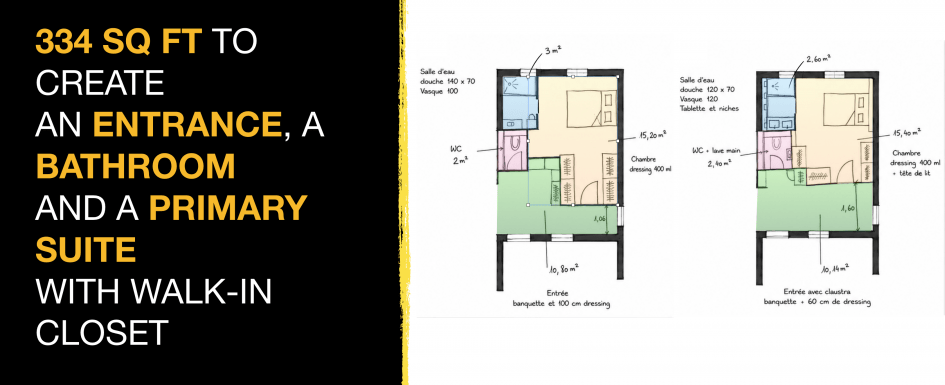
310 sq ft underused in a 1,400 sq ft house. The goal: create a real entryway with storage and seating, a private bathroom, a wet room, a master bedroom with closet and comfortable circulation between living and sleeping areas. Two floor plan scenarios were drawn before settling on the final version.
By Mathieu REY, Interior Design Specialist (updated June 2026)
310 sq ft. Two scenarios. One project to build — which layout to choose?
1. Assessment: constraints, plumbing and real margins
2. Scenario 1 floor plan
3. Scenario 2 floor plan
4. Version 3: the revised plan
5. 3D interior rendering: the project version
6. Frequently asked questions
Mathieu walks through both scenarios, the trade-offs and the final version in this video.
Assessing a 310 sq ft volume in a 1,400 sq ft house: constraints, plumbing and real margins
Before drawing anything, reading the volume is the first step. This 310 sq ft sits in a 1,400 sq ft house as the transition zone between living and sleeping areas. The program is precise: a functional entryway with storage and seating, a private bathroom, a wet room, a master bedroom with closet, and fluid circulation toward the living room, kitchen and the rest of the house.
The method starts with mapping existing constraints: drain and supply locations, window positions, electrical panel, load-bearing walls. Each element directly conditions the possible layouts. This preliminary work is what makes it possible to compare two floor plan scenarios realistically, without discovering problems when construction starts. To understand this method applied to a master suite, our article on closing a loggia to expand a master suite details the assessment steps.
On this type of project, drain location is the most constraining factor. It directly determines where the bathroom and wet room can go, which in turn defines the available surface for the closet and bedroom. That is why we always draw the bathroom first, before considering any other space.
Scenario 1 floor plan: how to position the entryway, bathroom and master bedroom in 310 sq ft
The first scenario proposes a logical and direct organization of the volume. The entryway is positioned at the front, with a built-in storage unit and seating integrated from the threshold. The private bathroom sits in a corner aligned with the existing drains. The wet room opens from the master bedroom, organized to accommodate a bed, a closet and sufficient circulation on each side.
This first scenario establishes a clear reference point: it meets the program, respects technical constraints and offers a straightforward reading of the volume. But it leaves open the question of closet optimization and entryway quality.
Scenario 2 floor plan: how to fit bathroom, wet room and closet in the same 310 sq ft volume
The second scenario starts from the same technical constraint but explores a different organization of volumes. It proposes a redistribution of the bathroom and wet room zone to free up a more generous closet surface on the master bedroom side, while maintaining a structured entryway. Circulation between spaces is rethought to avoid crossings and improve daily flow.
Comparing two floor plan scenarios makes visible what an empty volume cannot reveal: the impact of moving a partition wall by a few inches on the overall perception of the space, closet comfort and circulation quality.
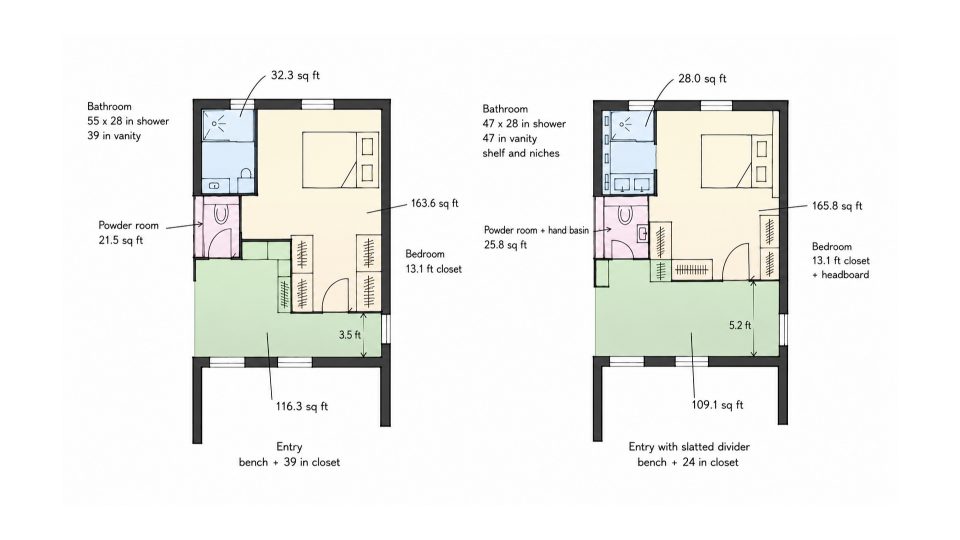
To make the trade-off easier, here is a summary of the advantages and disadvantages of the three versions studied:
| Scenario 1 | Scenario 2 | Version 3: hybrid alternative | |
|---|---|---|---|
| Entryway | +++ | + | ++ |
| Bathroom | + | +++ | ++ |
| Wet room | +++ | ++ | ++ |
| Closet | ++ | ++ | +++ |
| Claustra / screen | no | yes | yes |
| Circulation | ++ | ++ | +++ |
Version 3: pocket door, claustra, tank-top basin and 15.5 ft closet
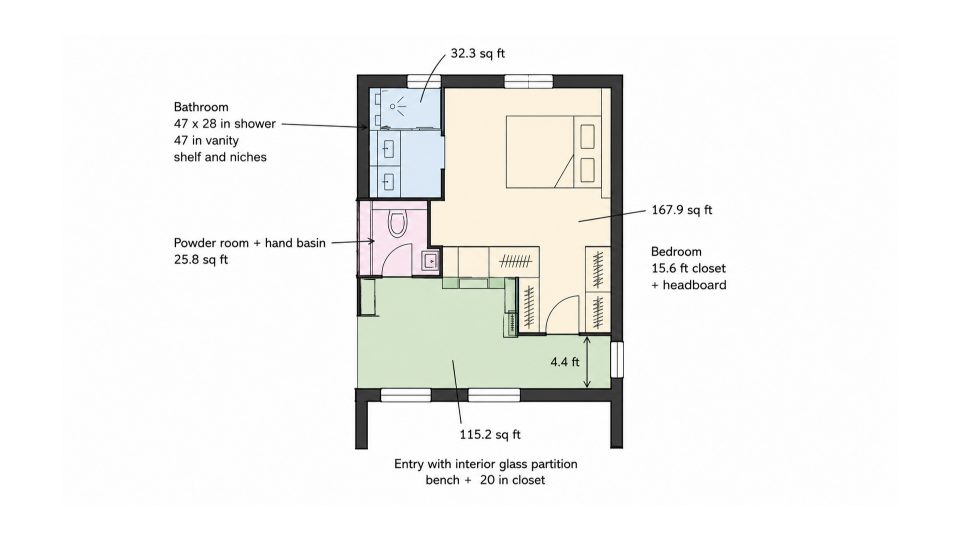
Version 3 is the result of comparing the first two scenarios. It integrates the best decisions from each and refines them. The wet room door becomes a pocket door to free up circulation space in the master bedroom. The bathroom integrates a tank-top basin to provide a hand-washing point without dedicating additional surface. A claustra structures the transition between the entryway zone and the sleeping area, creating a clear visual separation without fully partitioning the volume.
The result is a 15.5 ft closet, a good balance between entryway generosity and storage functionality on the bedroom side. This version guided the final design of the project, before moving to the technical drawing and 3D rendering phase. To go further on pocket doors in small spaces, our article on small bathroom remodel with closet conversion details the installation constraints.
The tank-top basin is often underestimated. It integrates a hand-washing point directly on the toilet tank, without additional plumbing or extra surface area. In a constrained volume, it is a simple technical solution that frees up space without compromising function. Check compatibility: the tank height must match the selected flush type.
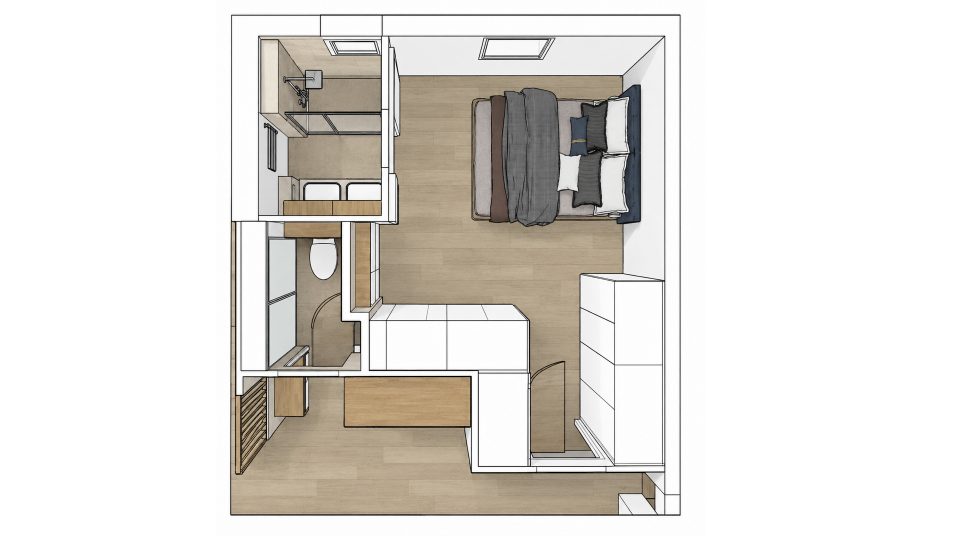
3D interior rendering: the project version before construction
The 3D rendering follows the revised 2D floor plan. It allows visualization of the space in its real volumes before any construction begins, verifying the consistency of heights, openings and planned materials, and anticipating issues related to natural light and circulation. This 3D version is exclusive to this article and does not appear in the video. Find our other master suite projects on our article on the loggia converted into a master suite.
Do you have a similar volume to organize on a floor plan? Work through your scenarios live with ArchiWorking.
Mathieu REY


Frequently asked questions about planning a master suite in 310 sq ft
How do you create a master suite with closet in 300 sq ft?
A volume of 300 to 310 sq ft can accommodate a master bedroom, a closet, a wet room and a private bathroom provided you work on a floor plan before any construction begins. The location of existing drains is the first factor to identify: it determines where the bathroom and wet room can go, which in turn defines the available surface for the closet. A 15.5 ft closet is achievable on this program.
Why compare multiple floor plan scenarios before choosing a layout?
Comparing two floor plan scenarios reveals what an empty volume cannot show: the impact of moving a partition wall by a few inches on closet quality, circulation flow and overall comfort. At ArchiWorking, we always recommend working through 2 to 3 layout scenarios to identify the advantages and disadvantages of each option before making decisions. Drawing by hand or with CAD software helps considerably in finding the best optimizations. If you are struggling to compare your options, the ArchiWorking Workshop is designed precisely to support you through this process.
What is a pocket door and when should you use one?
A pocket door slides inside the wall partition rather than swinging into the room. It eliminates the swing arc of a hinged door, which can free up 24 to 32 inches of usable surface in a bedroom or bathroom. Installation requires sufficient partition thickness and no technical conduit running through the planned pocket, to be verified on the floor plan before choosing.
What is a tank-top basin and when is it useful?
A tank-top basin is a hand-washing sink integrated directly onto the toilet tank. The water used for hand-washing then feeds the flush. It allows a water point to be integrated into a bathroom without additional surface or additional plumbing. It is a solution we use in many interior design projects: it makes use of a tight corner, optimizes constrained spaces and is particularly relevant in a master suite. For an example of this optimization applied to a full master suite, our article on the 270 sq ft basement master suite with closet, bathroom and home office presents this approach in a real context.
What is a claustra in interior design?
A claustra is a louvered or slatted partition, typically in wood or metal, that creates a visual separation without fully closing off the space. In interior design, it structures a transition between two zones — entryway and sleeping area for example — while allowing natural light to pass through and preserving a sense of space. It does not replace a soundproofing partition but brings strong spatial and decorative quality.
What is the minimum surface area to fit an entryway, bathroom, wet room and closet in a house?
280 to 320 sq ft is the range in which this program becomes comfortably achievable. Below 260 sq ft, compromises are required: either reduce the closet, remove the seating from the entryway, or opt for a more compact shower. The layout of load-bearing walls and drain locations can shift the usable surface by several square feet depending on the technical constraints of the project.
How do I get help drawing the floor plan for a master suite in 300 sq ft?
If you are stuck on the layout, the ArchiWorking Workshop is built for exactly this. Over a video call, Mathieu draws directly with you on your floor plan, up to 3 layout scenarios based on your real constraints: surface area, existing drains, load-bearing walls. You leave with a PDF file and usable plans. Single room 380€, full home 720€. Slots available within 48 hours at petale-de-carreaux.fr/atelier-amenagement-interieur/