
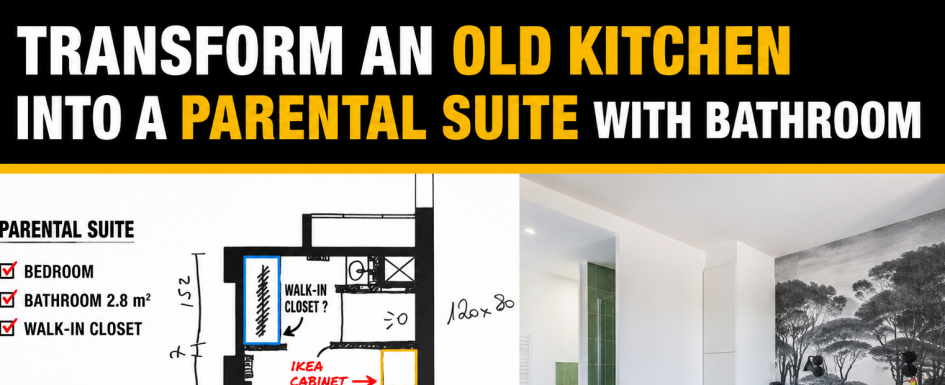
A 65 sq ft kitchen in a 970 sq ft apartment. The owner no longer used it in that configuration. The decision was radical: strip out the entire kitchen, remove the partitions, and convert that reclaimed space into a complete master suite with bedroom, walk-in closet, and bathroom. Here is how the project was designed on the floor plan and built, step by step. For more context on what makes a master suite work, see our guide on primary suite design: layout ideas and expert architectural tips.
By Clara AJMAR, Certified Interior Architect & Landscape Designer DPLG (updated June 2026)
Sometimes a layout calls for a radical choice. Here, that choice freed up 65 sq ft for a complete master suite.
1. How we turned an unused kitchen into a master suite: space and constraints
2. Master suite floor plan: bedroom, bathroom, and walk-in closet in the reclaimed space
3. 30 sq ft bathroom: walk-in shower, vanity, and storage optimization
4. Custom-look closet with Ikea Metod cabinets: method and trade-offs
5. Result: panoramic wallpaper, wood niches, and finishes
6. Frequently asked questions
Clara and Mathieu present the floor plan, technical decisions, and build of this master suite in this video.
How we turned an unused kitchen into a master suite: available space and constraints
The existing kitchen sat in an alcove off the main living area, closed off by partitions. At around 65 sq ft in a U-layout, it was a space the owner had stopped using in that form. Once the partitions came down and the kitchen was stripped out, the entire footprint became available to redesign. The kitchen was relocated to another part of the apartment as a separate project, so this space could be fully dedicated to the master suite.
The first constraint to resolve was drainage. An existing technical stack, approved by the building co-ownership for gray water, allowed a shower and sink connection. Toilets were not permitted on this stack — which shaped the program from the start: a wet room without a separate WC. For a full comparison of what a master suite can include at different sizes, see our detailed project of a 270 sq ft basement master suite with walk-in closet, bathroom, and home office.
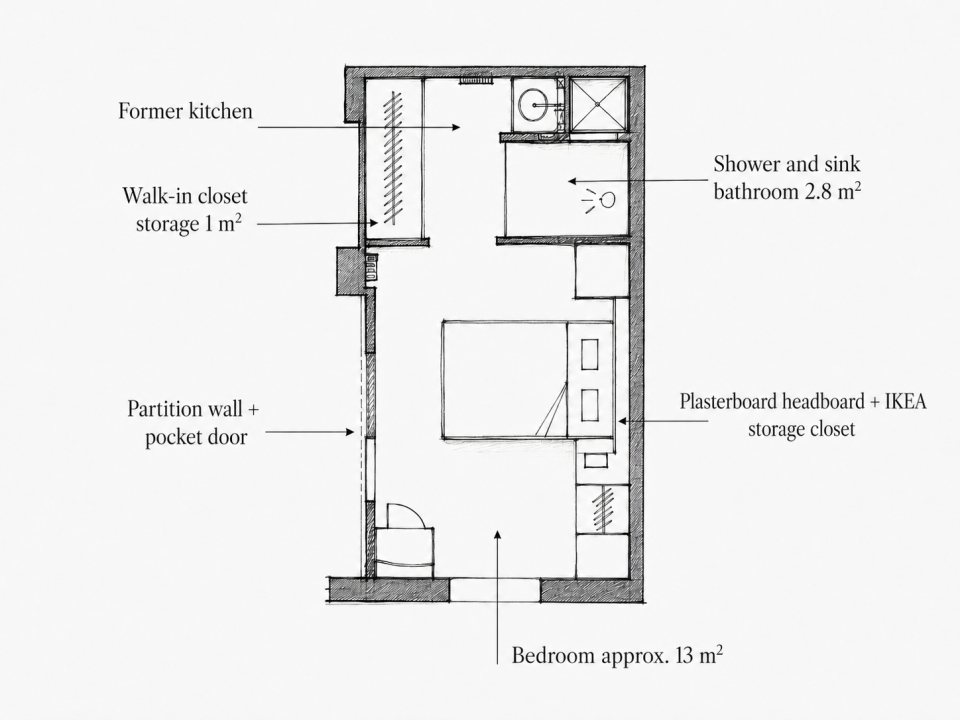
Master suite floor plan: bedroom, bathroom, and walk-in closet in the reclaimed space
The partitioning starts with a main wall separating the future suite from the living area, incorporating a double-stud pocket door to minimize floor clearance. The pocket door slides entirely into the wall thickness and keeps the full 31 in passage clear with no swing arc. The bathroom is positioned at the back of the space, with a reserved depth of 5 ft. The 3 in partition leaves 11 ft 2 in on the bedroom side.
A 24 in half-partition is drawn from the main wall to create an open passage into the walk-in closet, without an additional door. That 24 in depth matches a standard off-the-shelf closet unit exactly, which allows the cabinet to sit flush inside the recess without any custom fitting. The suite totals approximately 140 sq ft of usable space: 30 sq ft bathroom, a 3 ft 3 in walk-in closet run, and the remainder as bedroom with an integrated headboard and storage unit.
30 sq ft bathroom: walk-in shower, vanity, and storage optimization
In 30 sq ft, every inch matters. The walk-in shower measures 47 x 31 in and is positioned as close as possible to the technical stack to minimize horizontal drain runs. The central partition separating the shower from the vanity is thickened to allow niches on both sides: two tiled niches on the shower side for toiletries, two more on the vanity side for everyday storage. That extra wall depth — imposed by the plumbing — becomes a functional design element rather than wasted space.
The vanity has wall-mounted faucets and under-sink drawers, keeping the floor clear visually and making cleaning easier. A heated towel rail and a radiator complete the technical requirements of the room. Full-height tile in a soft green tone gives depth to a narrow volume.
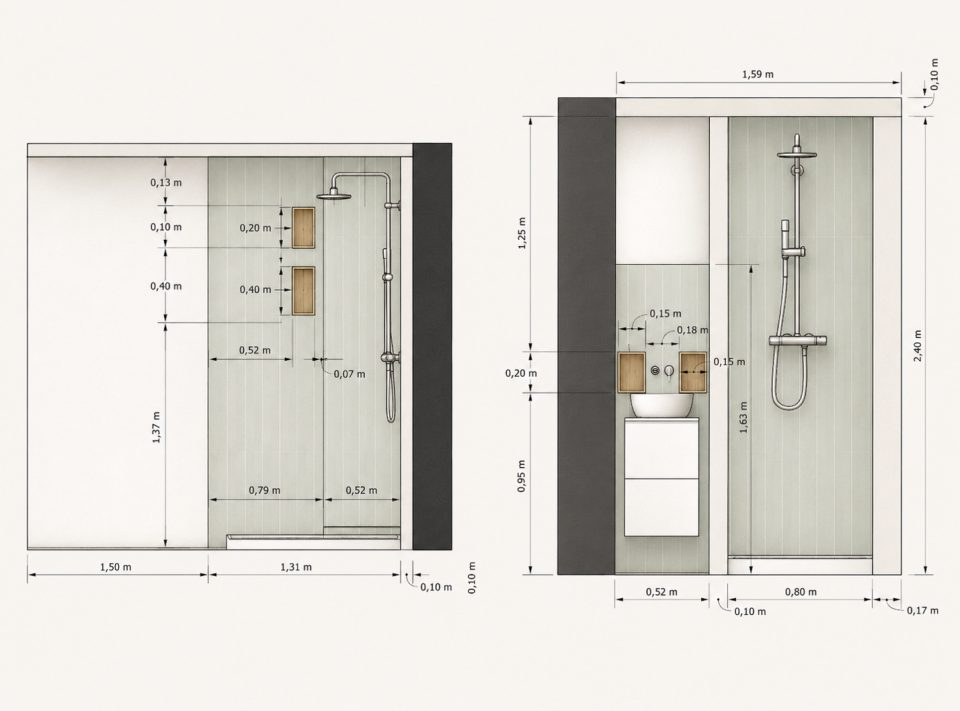
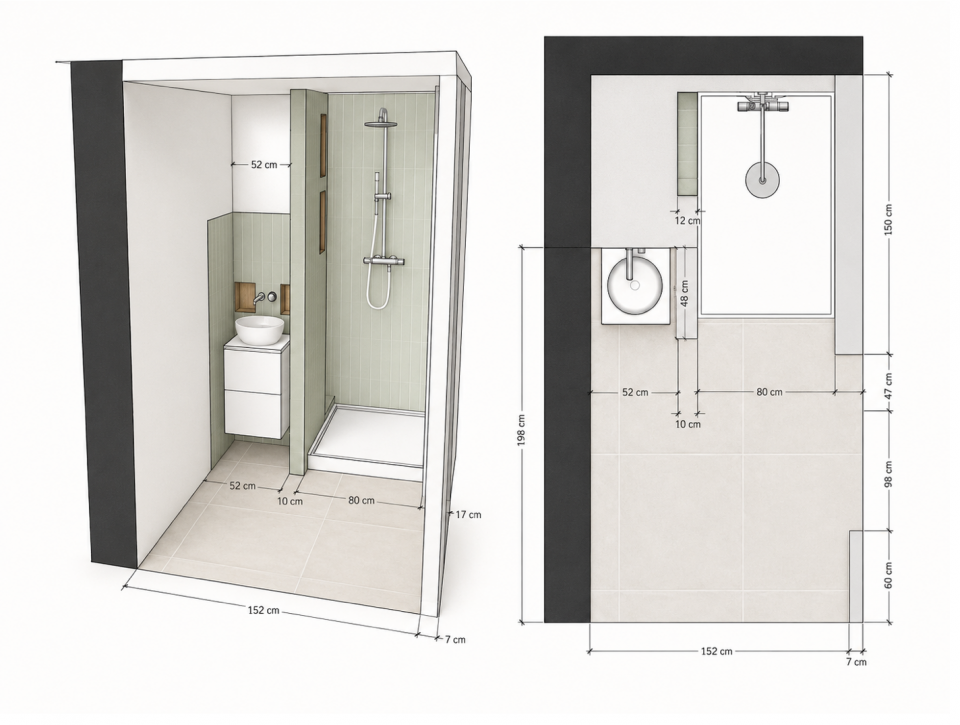
In a bathroom under 35 sq ft, the central partition is often the only surface available for built-in storage. Thickening it enough at the design stage allows niches on both sides without losing usable floor area. This is a decision to make before the walls go up, not after.
Custom-look closet with Ikea Metod cabinets: method and trade-offs
The headboard and closet run in an L-shape across the full wall length. The structure is built in drywall first — this forms the shape, the recesses, and the niches. Ikea Metod cabinet boxes are then set into the openings on each side: column units with drawers and shelves on the right, a mirrored layout on the left. At the center, a drywall shelf with a wood finish extends into a recessed zone where two open niches are integrated. The cabinet boxes slot in around that structure to create a unified look.
The result reads as bespoke millwork. Cabinet costs for this scope of Ikea Metod run between €1,650 and €2,200 depending on configuration, current promotions, and delivery. Minor variations are possible between orders. This range is a reliable ballpark, excluding installation labor. It is one of the best value-for-money approaches for this type of result, provided the drywall structure that carries the boxes is planned correctly upfront.
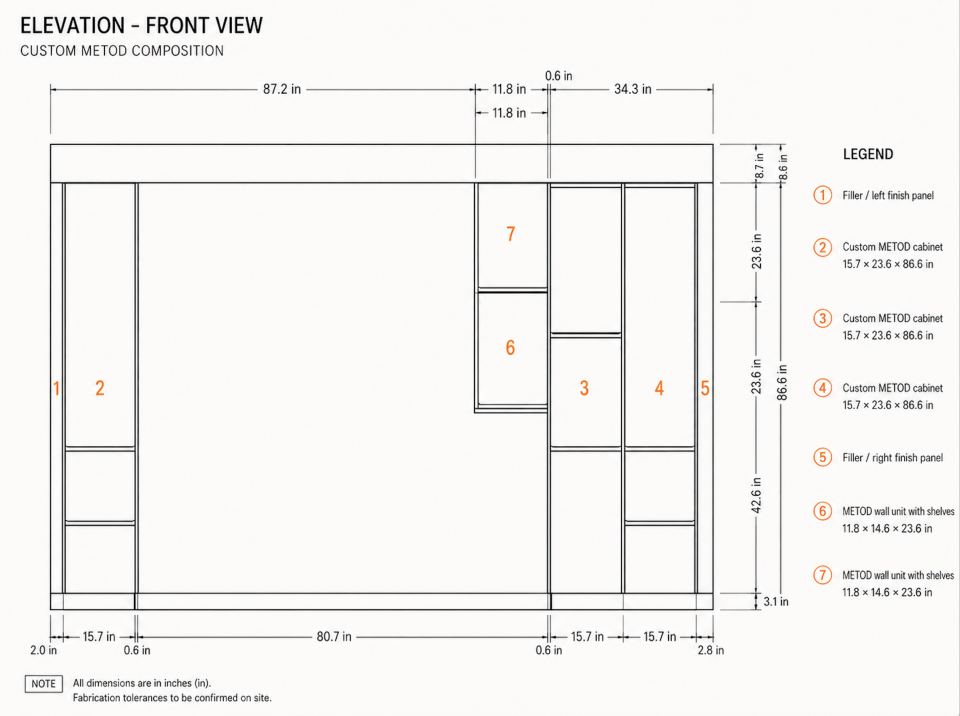
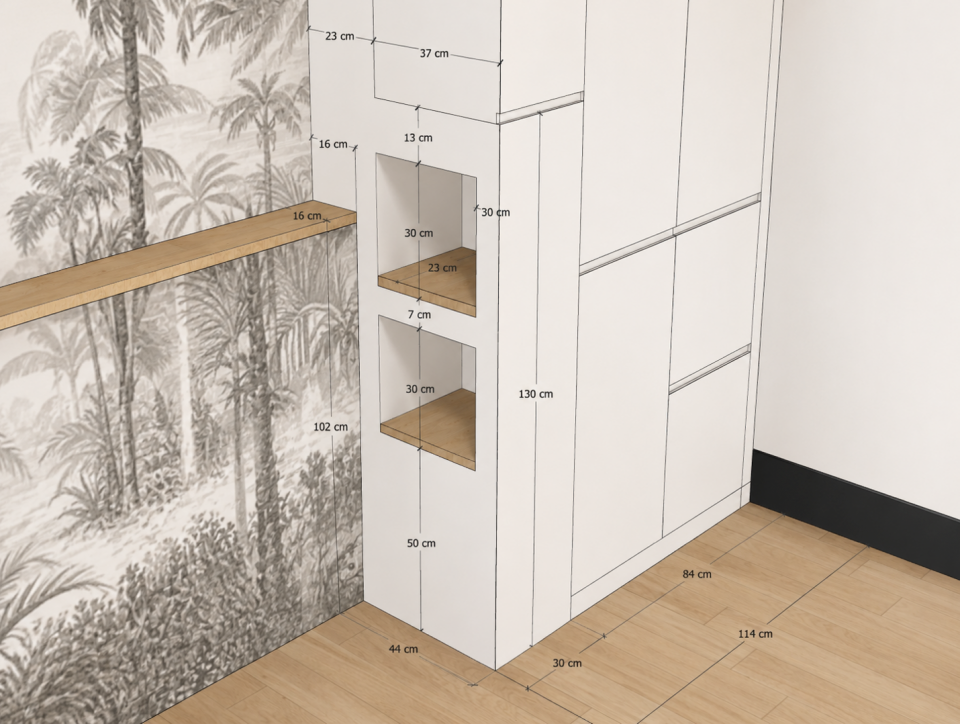
The Ikea Metod cabinet reads as custom because the drywall structure gives it its form. The cabinet fills the inside. The key is to dimension the drywall frame around the available Ikea module widths, not the other way around. Structure first, cabinet second: that sequence is what produces the bespoke finish.
Result: panoramic wallpaper, wood niches, and finishes
Once the drywall work is complete, the finishes tie the space together. Laminate flooring throughout, painted walls, and a full-wall panoramic wallpaper behind the headboard that adds depth to the central bedroom wall. The open wood niches at the center of the headboard composition create a warm material contrast against the white cabinet faces and the graphic wallpaper.
Lighting is layered: recessed downlights for general use, bedside wall sconces for atmosphere, a central pendant, and double task lighting inside the walk-in closet. Controls are grouped at the bedroom entry with a two-way switching setup for ease of use. A fold-down desk completes the program for occasional use without taking up permanent floor space. The bedroom has direct access to the terrace, which adds a significant quality-of-life dimension to the suite.
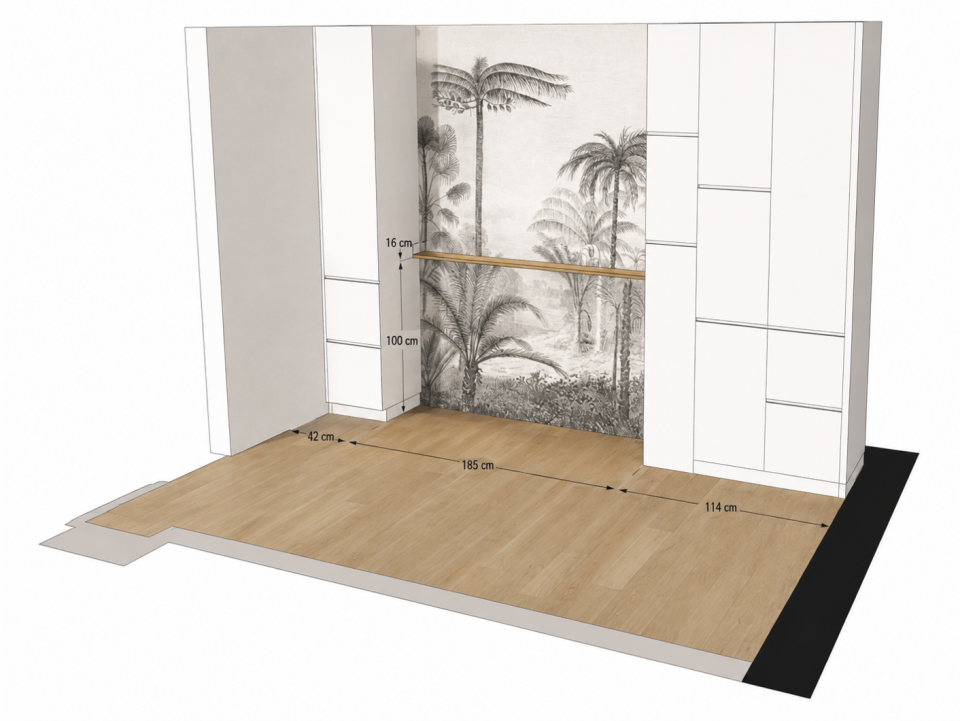
The result: 65 sq ft of former kitchen converted into a 140 sq ft master suite with a 30 sq ft walk-in shower bathroom, a 3 ft 3 in closet run, and a queen-size bedroom with integrated headboard storage. Designed around the real constraints: drainage stack position, existing partitions, and terrace access. Find all our renovation and floor plan projects on the ArchiWorking YouTube channel.
Clara AJMAR


Frequently Asked Questions About Converting a Kitchen into a Master Suite
Can you create a bathroom in a converted kitchen space without co-ownership approval?
It depends on the available drainage stack. If an existing gray water stack is nearby and the building allows connection for a shower and sink, it is possible to create a wet room without structural work on shared elements. Toilets almost always require prior approval from the co-ownership association. This verification is the first thing to check — it determines the entire program.
What is the minimum bathroom size in a master suite conversion?
27 sq ft is the viable minimum. At 30 sq ft, as in this project, it is possible to fit a 47 x 31 in shower, a vanity with under-sink storage, and a heated towel rail with workable circulation. The key is to position the shower pan as close as possible to the drain stack and to use the central partition for built-in niches on both sides.
How much do Ikea Metod cabinets cost for a built-in bedroom closet?
Between €1,650 and €2,200 for a scope equivalent to this project, excluding installation labor. Minor variations are possible depending on the configuration, current promotions, and delivery fees. The drywall structure that carries the cabinets is a separate cost to factor in with your contractor, but it is what produces the bespoke finish.
How do you create a headboard with built-in storage without full custom millwork?
By combining a drywall structure — which provides the shape, recesses, and open niches — with Ikea cabinet boxes set into the openings. The drywall is built first to the dimensions of the available Ikea modules. The cabinets slot into the frame. A wood-finish shelf at the center and the open niches complete the composition. The result looks custom; the cost is a fraction of traditional joinery.
Is a fold-down desk worth including in a master suite of 140 sq ft?
Yes, for occasional use. A fold-down desk takes up no permanent floor space and folds flat against the wall when not in use. In a master suite, it handles intermittent tasks — laptop work, reading, paperwork — without the space cost of a permanent desk. It is most effective when built into the headboard wall composition so it disappears visually when folded.